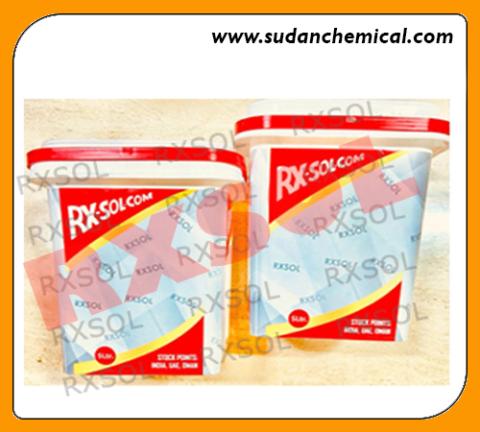
Product code: RXSOL-19-1503-005
The addition of Acid corrosion Inhibitor RXSOL 213, inhibitors to hydrochloric acid solution provides maximum protection for equipment during,The removal of lime deposits or water scale from power plant boilers and piping systems and from evaporating equi
Inhibitor for ACID
Acid corrosion Inhibitor RXSOL 213 is an organic, liquid, cationic corrosion inhibitor especially designed to inhibit the attack of hydrochloric acid oiron and steel during industrial cleaning operations. It also inhibits acid attack on copper and brass. It does not contain arsenic, chlorinated hydrocarbons, or lead compounds.
Application
The addition of Acid corrosion Inhibitor RXSOL 213, inhibitors to hydrochloric acid solution provides maximum protection for equipment during:
A. The removal of lime deposits or water scale from power plant boilers and piping systems and from evaporating equipment.
B. The removal of scale and deposits from equipment in refineries, utility companies,paper mills, chemical plants and other industries.
Acid corrosion Inhibitor RXSOL 213 inhibitors meet the requirements of Military Specification Nos.MIL-I-17433 and MIL-C-17434.
Dosage
For each For each 1000ltrs of pickling bath RODINE 31A must be added at the rate of 1 to 5ltrs (1.1 - 5.7kgs)* hydrochloric acid solution, not less than the following amount of Acid corrosion Inhibitor RXSOL 213 inhibitor should be used:
The exceptional strength and heat stability of Acid corrosion Inhibitor RXSOL 213 give the user a considerable safety factor in relation to temperature, acid strength, and time. Acid corrosion Inhibitor RXSOL 213 may be added to either the diluted or concentrated hydrochloric acid. In either case, Acid corrosion Inhibitor RXSOL 213 should be thoroughly mixed with the acid by stirring or agitation.
The hydrochloric acid solution inhibited with Acid corrosion Inhibitor RXSOL 213 is best circulated through the equipment to be cleaned. When circulation cannot be accomplished, the equipment should be filled with the inhibited acid and allowed to react for sufficient time to remove the objectionable deposits. To estimate the proper acid concentration and cleaning time, samples of the deposits to be removed can be tested in the laboratory prior to cleaning. If heating of the equipment to be cleaned or acid solution is desired to speed the cleaning action, it should be done prior to the start of the cleaning operation