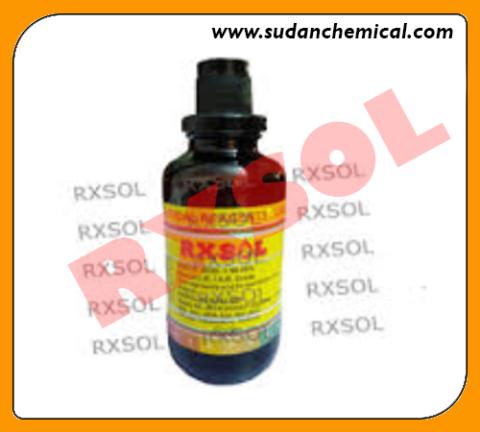
Product code: RXSOL-60-6405-100
Iodine
Iodine, a diatomic molecule (I2), is an oxidizing agent and solutions of it are frequently used in chemical analyses. Iodine suffers from low solubility in water and its volatility makes it difficult to handle directly. Both these problems are overcome by the addition of an Iodide salt (usually Potassium Iodide) which forms a Triiodide (I3-) complex with the Iodine. The Triiodide complex is extremely soluble in water and has decreased volatility.
Application
Iodine solutions are typically standardized with Sodium Thiosulfate solutions or Arsenic Trioxide. The equation for reaction with Sodium Thiosulfate is:
See the Tech Tip under Arsenic Trioxide for information on standardization with Arsenic Trioxide.
Dosage
In order to minimize errors due to oxidation of the Iodide to Iodine, titrations involving Iodine solutions should be made in the pH range of 4 - 8, and contact with air should be minimized. Because of this oxidation tendency as well as the volatility of this element even in the Triiodide form, Iodine solutions should be restandardized periodically for increased accuracy, especially after the bottle has been opened. Starch forms an intensely blue complex with Triiodide and is almost always used as the indicator when the endpoint is not determined instrumentally.